Peru is a colorful land of textiles, ancient ruins, and incredible culture. It’s also home to one of America’s favorite foods-and an interesting national dish!
Antiquity
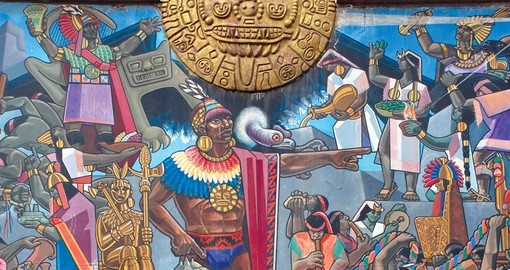
The Inca Empire became an empire, they migrated into the fertile Cusco Valley. Manco Capac became the first Inca king sometime in the 11th century. But it wasn’t until 1438, under the reign of Pachacutec, that the empire began to expand on a larger scale with new areas incorporated through conquest, coercion, or alliance. Machu Picchu was constructed in 1450 as a royal estate for Pachacutec and his lineage. and The incredibly rapid expansion of the Inca empire began with Viracocha’s son Pachacuti, one of the great conquerors—and one of the great individuals—in the history of the Americas. With his accession in 1438, reliable history also began, almost all the chroniclers being in practical agreement. Pachacuti was called by the British geographer-historian Sir Clements Markham “the greatest man that the aboriginal race of America has produced.” He and his son Topa Inca Yupanqui may be aptly compared to Philip and Alexander of Macedon. Pachacuti was evidently a great civic planner as well; tradition ascribes to him the city plan of Cuzco as well as the erection of many of the massive masonry buildings that still awe visitors to that ancient capital.
The west coast of South America grew after Vasco Núñez de Balboa discovered the Pacific Ocean in 1513, but it was not until 1524 that Francisco Pizarro, aided by another soldier, Diego de Almagro, and a priest, Hernando de Luque, undertook explorations that led to the conquest of Peru.
Spanish conquistador Francisco Pizarro arrived again in Peru in 1532 to establish the first Spanish town before setting off towards Incan territory. An incredible Spanish cavalry met an Incan people who were weakened both by civil war and by European diseases that had made their way through the continent. Although there were rebellions, the Spanish were able to push the Incan people to retreat and they were never able to recover the power they once held.
In 1541, Pizarro was assassinated in Lima by his former associate Diego Almagro. In 1542, Spain created the Viceroyalty of Peru, comprising most of South America except Brazil.

From 1808 to 1822, Spanish America fought for its independence from the Crown. In Peru, small-scale revolts had begun decades earlier, for example during the Tupac Amaru Rebellion in 1780-81 which was crushed and ended with the brutal executi
But Peru remained loyal because of the conservative attitude of the Peruvian aristocracy, the presence of many Spaniards in Peru, the concentration of Spanish military power in lima, and the effective suppression of Indian uprisings. Peru’s independence was, consequently, achieved primarily by outsiders.
At the Battle of Iquique (then in Peru, now in Chile), on May 21, 1879, the Peruvians suffered the loss of one of their best warships, the Independencia; then the Huáscar was captured on October 8, and this eventual surrender of control of the sea permitted a Chilean army to land on the Peruvian coast. On Jan. 17, 1881, Chilean forces captured the capital, Lima. Looting and pillaging followed, and the National Library was destroyed. According to the terms of the Treaty of Ancón (Oct. 20, 1883), Peru turned over to Chile full possession of the province of Tarapacá and the administration for 10 years of the provinces of Tacnaand Arica, after which a plebiscite was to determine their future sovereignty.
Expenditures for the war, and the consequent loss of revenue from the nitrate fields, created the possibility of imminent bankruptcy. To avert this disaster, the Civilian regime accepted in 1889 a plan proposed by the bondholders for handling the debt. The Peruvian Corporation, representing the creditors, with headquarters in London, was to control the railroads for 66 years, to mine up to three million tons of guano, and to receive 33 annual payments of £80,000 each. The plan worked satisfactorily but was hated by the Peruvian people.
Peru gained its independence from Spain in 1821 with the help of Simón Bolivár who went on to rule the country. Over the next one hundred years, Peru’s relations with its neighbours was not always stable resulting in wars that greatly impacted the country’s economy as well as loss in territory. The 20th century in Peru was characterised by a series of military dictatorships and coups and the 1960s and 1970s were particularly difficult. While the country began to recover economically during the 1990s, President Alberto Fujimori faced charges of corruption, human rights violations and more and was forced to resign in 2000.